DevExtreme — Year-End Roadmap v26.2 (React, Angular, Vue, jQuery & ASP.NET Core)

The features/capabilities we expect to ship in our next major update apply to both DevExtreme JavaScript component libraries (Angular, React, Vue, jQuery) and DevExtreme-based ASP.NET MVC/Core controls.
To help us fine tune our release plans, please respond to the survey questions embedded within this post. Alternatively, submit a support ticket via the DevExpress Support Center. We will be happy to follow up.
Roadmap Updates
This roadmap will be updated regularly to reflect development progress. As we near our official release, we expect to add additional items and modify the status of planned features as necessary. Look for the following labels next to each feature:
DevExtreme AI Agent Skills — Planned Enhancements
In v26.1, we published a set of AI Agent Skills for DevExtreme. These skills help AI coding agents generate higher-quality code that adheres to DevExtreme APIs, patterns, and best practices.
We expect to improve these skills in upcoming release cycles. Planned updates include:
- Improvements to existing skills
- New skills for additional components and usage scenarios
- ASP.NET Core support
Security — SBOMs and CRA Readiness
If you deliver software in the EU, the Cyber Resilience Act (CRA) will require a Software Bill of Materials (SBOM – an inventory of every component inside your solution) as part of your conformity documentation. The CRA and its associated regulatory regime will go into effect on December 2027. Each software application/solution manufacturer must fulfil SBOM-related obligations. DevExpress-authored SBOMs will help customers document/inventory DevExpress libraries used within a DevExpress-powered app.
Most dependency scanners and SBOM generation tools read what a NuGet package declares (its dependencies on other NuGet packages) and stop there, which leaves two gaps we fill:
- Components embedded inside a package. Some DevExpress NuGet packages bundle fonts and third-party JavaScript libraries. Package metadata has no way to declare them, so a scanner never reports them — even though their licenses and vulnerabilities are as real as those of any declared dependency.
- Developer dependencies. Libraries we use to build our products never reach users, so we mark them with
scope: "excluded". We list these libraries regardless, because all vulnerabilities should be documented.
We released a preview version of DevExpress-authored SBOMs in May 2026 (for our .NET NuGet packages). SBOMs for CRA Compliance in DevExpress-powered Apps describes what the files contain and how to feed them into tools such as Dependency-Track, Trivy, and Grype. With v26.2, we expect to extend coverage to NPM packages and DevExpress VCL libraries, take our SBOMs out of preview and make them available to every customer.
DataGrid Enhancements
Semantic Search
v26.2 will introduce a new DevExtreme DataGrid Semantic Search option – one that integrates the component with an AI-powered semantic search backend. Semantic search uses AI embeddings to locate data records based on meaning rather than exact wording. To filter date, the backend processes the context and intent behind a question or phrase.
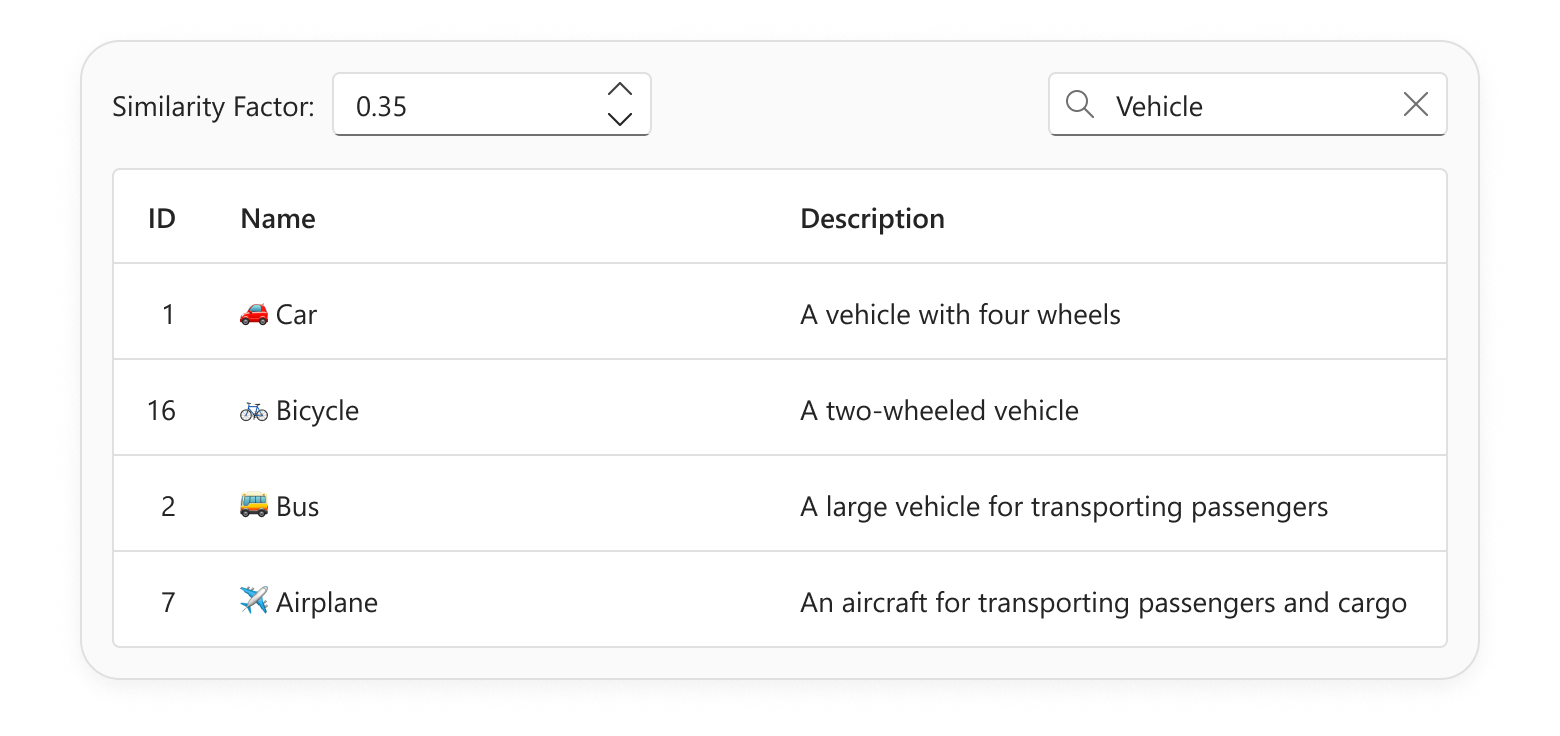
Semantic search is perfect for unprocessed/uncategorized data sets (where configuring filters for exact values may be tedious). By using longer/specific queries, this option can help users locate records more effectively. To control search precision, users will be able to fine-tune search results using a similarity factor.
Semantic search requires resource-intensive data vectorization. This process is best suited for the server-side, especially for large data sets with records in the tens of thousands. We will demonstrate how to implement semantic search using an ASP.NET Core backend that is tailored to the DevExtreme DataGrid. The UI component itself will require minimal configuration on the client side.
AI-powered Detail View
We expect to add AI-driven data analysis for those using our DataGrid's master-detail view. This new option will allow users to interrogate individual records using natural language.
In v25.2, we added an AI column to our DataGrid. This feature helped analyze component data using an AI prompt. While valuable, certain usage scenarios do not require generated data for every row. Instead, users may need on-demand data generation for specific rows. Our new AI detail scenario will offer this capability, which can significantly reduce AI token consumption and enhance data generation performance.
Our new AI master-detail feature will also display generated content in a format better suited to longer, more in-depth insights. This option will include a prompt-driven data analysis UI within the DataGrid’s master-detail interface, spanning the full width of the component.
Within the detail row, users will be able to ask questions about the active record and receive AI-generated insights. The AI assistant will be able to summarize record data, clarify complex values, highlight notable patterns, and obtain contextual information specific to the active record.
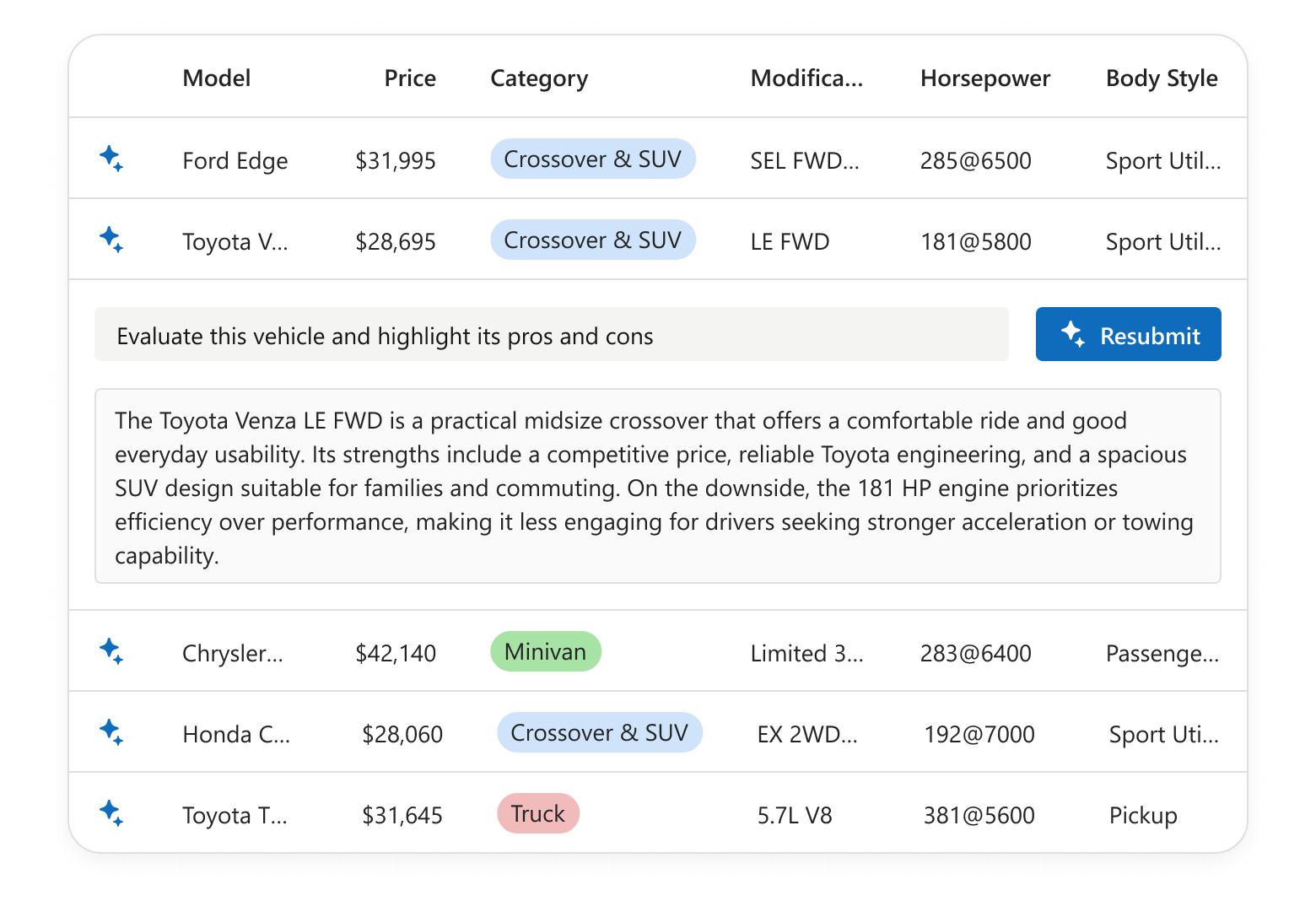
This option is particularly valuable for data-intensive applications where records contain many fields or complex business information. Instead of searching through multiple columns and analyzing data manually, users can obtain necessary information using a natural-language prompt. This will improve both user productivity and your application's overall user experience.
DevExtreme Chat — Tool Call Visualization
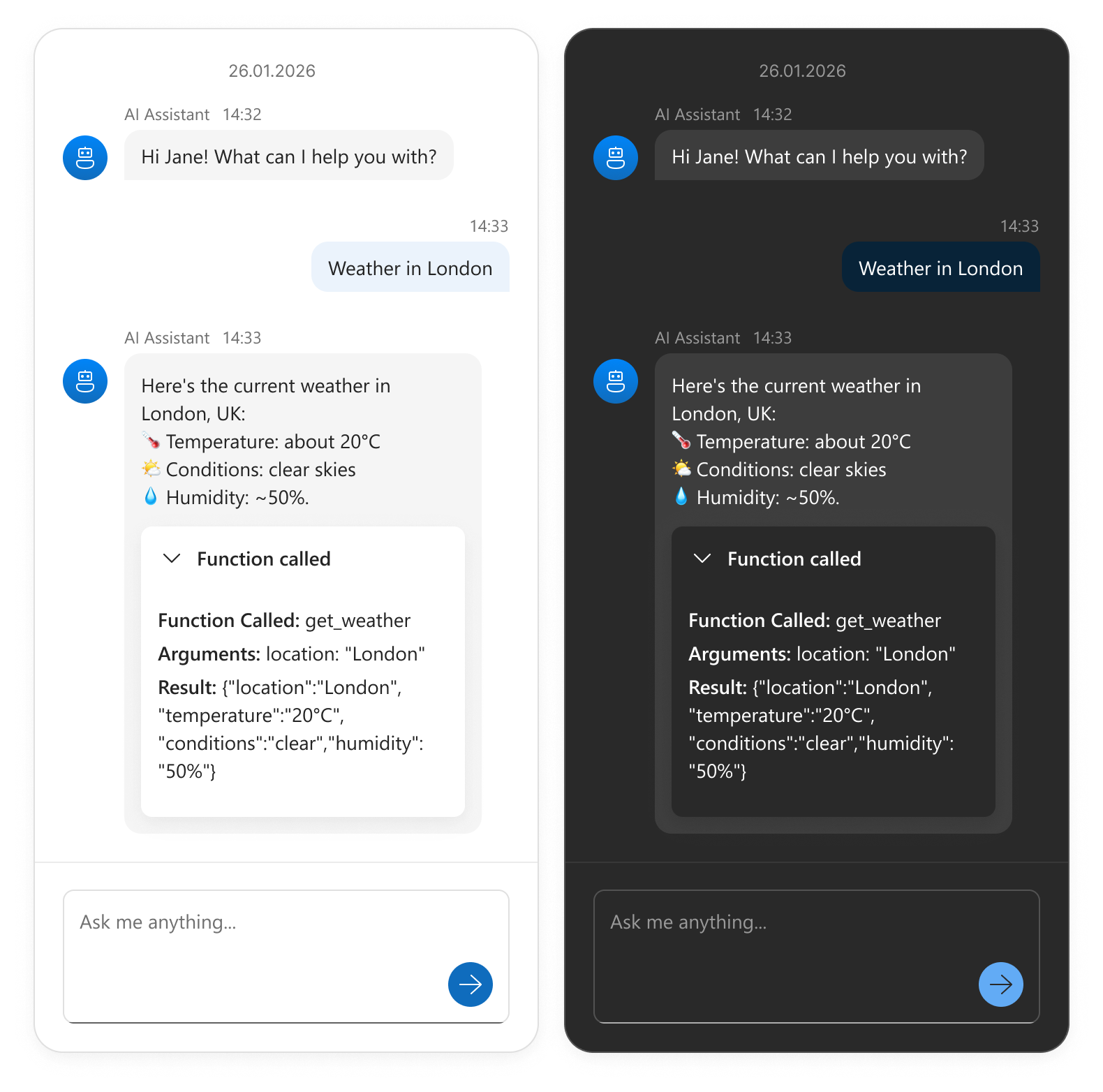
We expect to add the ability to display AI tool/function calls in the DevExtreme Chat message body. These tools/functions can be declared locally within the app or available via MCP servers.
This visualization will increase clarity and transparency. Chat users will be able to see which tools were used, their order, and parameters alongside the AI response.
DevExtreme Scheduler — Hierarchical Resource Grouping
DevExtreme Scheduler currently supports appointment grouping at a single resource level. With v26.2, we will extend this behavior with hierarchical (multi-level) resource grouping based on direct parent-child relationships in your resource data source.
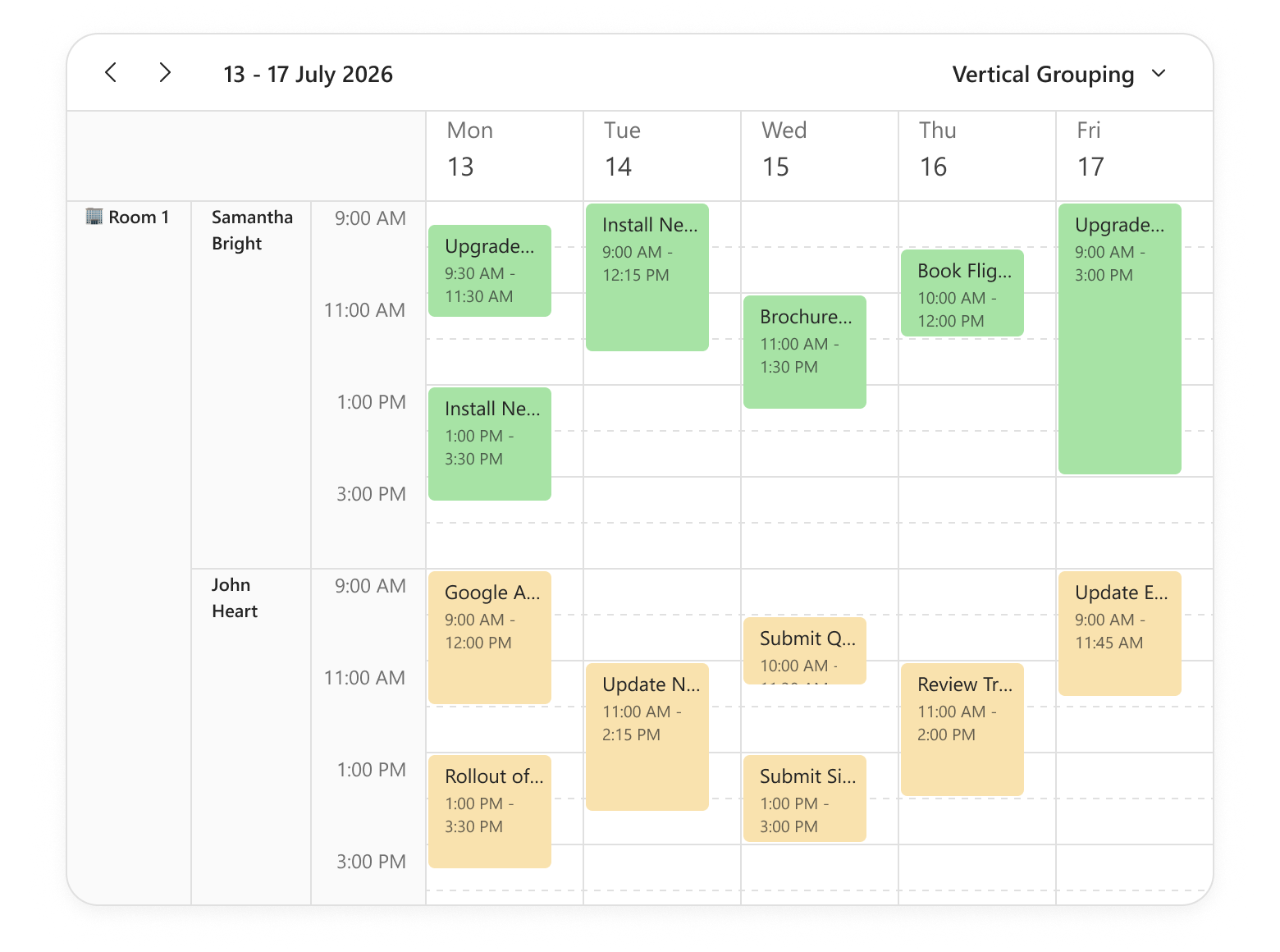
Planned capabilities will include:
- Multi-level (parent-child) resource grouping with unrestricted nesting depth
- Nested row headers for Timeline view and nested column headers in Day/Week views (both vertical and horizontal grouping)
- Appointment rendering in the correct leaf resource while preserving existing appointment drag-and-drop behavior
This capability is especially valuable for applications that schedule appointments across layered resource hierarchies, such as departments and employees, buildings and rooms, or teams and equipment. You will be able to define parent-child relationships between resources and control which child resources belong to each parent, creating a clear and intuitive hierarchy.
DevExtreme Map — OpenStreetMap (OSM) Support
We expect to add OpenStreetMap (OSM) support to the DevExtreme Map component. The new provider will allow you to connect the Map to OSM-compatible tile, geocoding, and routing services, including commercial providers and self-hosted infrastructure.
Planned capabilities will include:
- Support for core Map features, including markers, routes, and tooltips
- Additional configuration options for OSM-based services
- Greater control over service selection, deployment model, and mapping infrastructure
Globalization – Separate Text and Date/Number Locales
With v26.2, you will be able to specify different locales for application text values and dates/numbers. You will be able to change languages without affecting date/number formatting and vice versa.
Accessibility
We expect to improve accessibility for the following DevExtreme UI components:
Our long-term goal is to address all limitations identified in our DevExtreme Accessibility Conformance Reports (ACRs).
DevExtreme PivotGrid — Keyboard Navigation and ARIA Attribute Updates
With v26.2, we expect to improve PivotGrid keyboard navigation and ARIA semantics to support a more accessible interaction model.
Planned enhancements include:
- Consistent arrow-key navigation across column headers, row headers, and area items
- Keyboard access for expand icons and column sort operations
- Keyboard-accessible Field Chooser content with visible focus states
- Focus returned to the trigger button when a popup closes
- Header filter activation from keyboard input with an aria-label that includes column context
- ARIA grid semantics alignment, including header-to-data associations and aria-rowindex/aria-colindex metadata for clearer screen reader announcements
- Keyboard access for scrollable regions and keyboard commands for context menus
DevExtreme Toolbar — Enhanced Keyboard Navigation
We expect to align "focus management" in the DevExtreme Toolbar with W3C Toolbar pattern recommendations.
Keyboard users will navigate the Toolbar with a single Tab stop and arrow keys between items, instead of tabbing through each item individually — a faster, less error-prone path through the toolbar. Items containing other components (for example, a search box) will support the same model:
- Arrow keys reach the item.
- Enter or Space moves focus inside the item.
- Esc returns to the toolbar.
A visible outline on the focused item will allow users to track keyboard focus.

The same navigation model will extend to built-in toolbars in the following DevExtreme components:
- DataGrid
- File Manager
- HTML Editor
- Scheduler
- TreeList
- Rich Text Editor for ASP.NET Core
- Spreadsheet for ASP.NET Core
We will also add an option to preserve behaviors within applications that require our previous implementation.
Globalize — Deprecation Plans
DevExtreme supports two localization/internationalization libraries: Intl and Globalize.
Globalize is currently in maintenance mode and may introduce long-term security and reliability risks. We plan to deprecate Globalize support in our next two major release cycles (v26.2 and v27.1) and remove support in subsequent releases.
We will publish migration guidance to help you transition with minimal disruption.
If you currently use Globalize, we would appreciate your feedback. Your input will help us understand real-world usage scenarios and assess the impact of this change.
ASP.NET Core
.NET 11 Support
DevExpress ASP.NET Core controls will support .NET 11 (both v26.1 and v26.2) following Microsoft's official release.
Minimum Supported .NET and Visual Studio Versions
As you may know, .NET 8 and .NET 9 will reach end of support on November 10, 2026. We will therefore raise our minimum supported .NET version to .NET 10 once we release v26.2 in December. The minimum .NET Framework version will remain 4.6.2.
Visual Studio 2022 will be the minimum supported IDE version when v26.2 ships.
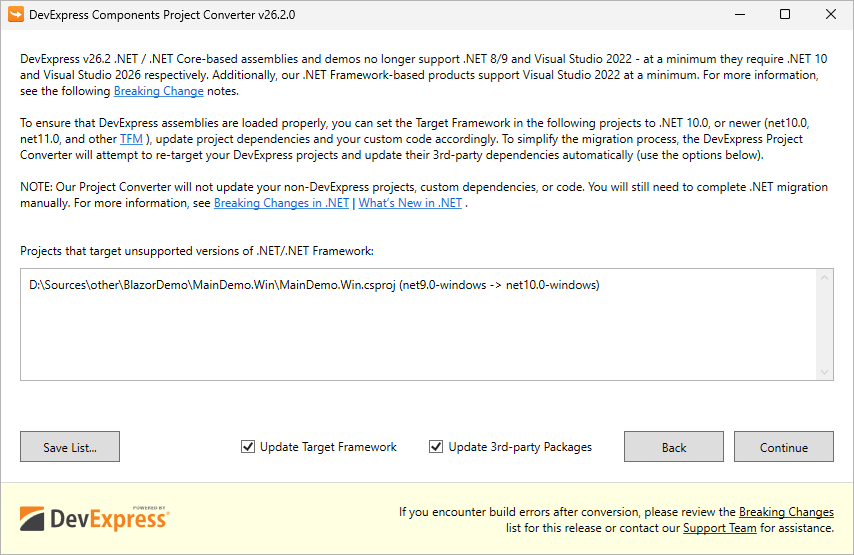
Automatically Re-target DevExpress-based Projects to .NET 10 and Update 3rd Party NuGet Packages
For .NET/.NET Core, we recommend using the DevExpress Project Converter to update all DevExpress-related and third-party project references, packages, and configurations automatically. See also a related Breaking Change notice.
Separate NuGet Packages for Different .NET Versions (.NET 10, .NET 11, etc.)
Today, third-party dependencies are automatically patched after a detected vulnerability (for example, a vulnerability in System.Security.Cryptography.Xml) only for the minimally supported .NET version (today it's .NET 8). Today (with v26.1, v25.2, v25.1, v24.2), manual version pinning (Solutions #1 or #2 from this article) may still be required for .NET 9/10-based projects depending on their exact TFM and project SDK. We will provide .NET-specific dependency groups in DevExpress NuGet packages, which will simplify use of v26.2.
WCF Dependency Will Be Removed from XPO and Printing Core Libraries
These core libraries currently include references to WCF (Windows Communication Foundation), a standard library with a well-documented history of vulnerability disclosures in its dependencies ("thanks" to System.Security.Cryptography.Xml). We will remove these WCF references from DevExpress.Xpo core and DevExpress.Printing.Core libraries in v26.2. .NET Framework users will use the new DevExpress.Xpo.Services and DevExpress.Printing.Remote libraries instead (if you need this advanced and rarely used WCF functionality). The Project Converter will update project references automatically, so you should not encounter upgrade-related issues.
Improved Localization Support with AI-powered Translations
We expect to ship complete built-in localizations for a selected set of languages in the new DevExpress Localization Tool. Professional translators have already translated and reviewed approximately 80% of our German localization. To broaden language coverage while maintaining translation quality, we plan to leverage AI-powered translation workflows. The workflow will not rely on direct translation alone - it will also consider additional context:
- Usage context - how each string is used, collected from our source code.
- Established Microsoft terminology (obtained from the Microsoft Terminology Collection).
Web Localization Service — Supported Versions Limited to v23.2+
User translations for v23.1 and earlier releases will no longer be available through the Localization Service UI (view, edit, download, create). These translations will be retained by DevExpress should you require them. You can request your old translation archives via the DevExpress Support Center.
Your Feedback Matters
Free DevExpress Products - Get Your Copy Today
 Svetlana Troitskaya (DevExpress)